Inquire
School of Nursing
Okanagan Campus
ubco.nursinggrad@ubc.ca

Students gain valuable knowledge in leadership, research, education and policy. Learn from leading nursing education, practice and research scholars while contributing to the development and application of nursing knowledge.
| Program | Components | Expected Duration |
| MSN Course-Based | Coursework and capstone | 16 months (full time) |
| MSN Thesis-Based | Coursework and thesis | 24 months (full time) |
MSN Summer 2024 Core course dates (weekdays only, full days approx. 8am-4pm, online delivery):
Please note that there are trailing requirements for each Intensive course, and the last assignment is due several weeks after the last day of class
The course-based MSN program welcomes RNs from a broad range of interests and backgrounds who wish to pursue careers in health leadership and/or education.
Masters-level coursework is normally taken at the 500-level. Three credits of undergraduate level coursework (300-499) may be taken with the approval of the Graduate Program Coordinator.
The objectives of the MSN program are to prepare nurses who are innovative, creative, evidence-informed problem-solvers who can collaboratively lead interprofessional teams.
These objectives will be achieved through a program of studies that prepares nurses to:
For more program information, see our MSN/PhD Nursing Handbook. For information about courses and schedules see Program Requirements in the Academic Calendar.
Thesis-based programs (thesis-based MSN, PhD in Nursing) require students to complete their research projects under the supervision of a School of Nursing faculty member; a prospective student’s proposed research plan must fit within a Supervisor’s area of research. Thesis-based students pursue academia and research careers; a thesis-based MSN is preferred over a course-based MSN for admission to PhD studies, but is not required.
Masters-level coursework is normally taken at the 500-level. Three credits of undergraduate level coursework (300-499) may be taken with the approval of the Graduate Program Coordinator.
The objectives of the MSN program are to prepare nurses who are innovative, creative, evidence-informed problem-solvers who can collaboratively lead interprofessional teams. These objectives will be achieved through a program of studies that prepares nurses to:
For more program information, see our MSN/PhD Nursing Handbook. For information about courses and schedules see Program Requirements in the Academic Calendar.
In partnership with communities, health professionals, academic collaborators and other stakeholders, we are leading interdisciplinary research teams to generate and translate knowledge into effective evidence-based practices and programs. The School of Nursing’s Research and Knowledge Hub is an open community that is home to four areas of research excellence:
Despite a vast body of evidence and practical policy solutions, systematic differences in health and health outcomes persist along social gradients—both within and between countries. These differences, or health inequities, are human-caused and unfair. This research lab focuses on supporting people to develop meaningful ways to align their good equity intentions with the evidence about what causes health inequities. Current research lab:
Working together with health-care professionals and communities, our nursing researchers are leading the development of innovative health and social service solutions to inform policy and system change to address priority health challenges. Current research labs in the group:
Advancing health equity is the foundation of this research theme. Programs of research focus on advancing equity in research, health and social systems as well as health promotion and health system change with and by Indigenous peoples and diverse communities as partners in decision making to improve health outcomes. Scholars in this theme use various research methods, particularly community-led, integrated knowledge translation and patient/community-oriented research to promote equity and inclusion. Current research labs in the group:
Our faculty is at the forefront of innovations in nursing and interprofessional education, and creating learning partnerships with health-care providers, families, patients and caregivers to develop knowledge and skills for building better patient-oriented approaches to health care.
Charlene Esteban Ronquillo | charlene.ronquillo@ubc.ca | Research interests: Health informatics; nursing; health equity; implementation science
Joan L. Bottorff | joan.bottorff@ubc.ca | 250.807.8627 Research interests: Health promotion, chronic disease prevention, gender, health behaviour change, men’s health, smoking cessation, knowledge translation, e-health.
Carla Hilario | carla.hilario@ubc.ca | Research interests: Health equity; youth mental health; community resilience; implementation science.
Donna Kurtz | donna.kurtz@ubc.ca | 250.807.9627 Research interests: Indigenous health, health promotion, chronic disease prevention, health disparities, women’s health, cultural safety, primary health care.
Nelly D. Oelke | nelly.oelke@ubc.ca | 250.807.9880 Research interests: Health services, primary health care, health policy, chronic disease management, mental health, rural health, vulnerable populations.
Elizabeth Keys | Elizabeth.Keys@ubc.ca Research interests: Pediatric sleep; Parent-child interactions; Infant and parental mental health; eHealth and precision health; Community engagement; Community and public health nursing; Mixed methods; Knowledge synthesis; Integrated knowledge translation and implementation science
Lise Olsen | lise.olsen@ubc.ca | 250.807.9180 Research interests: Health promotion, injury prevention, child health, physical activity, children with disabilities, autism, family support.
Barbara Pesut | barb.pesut@ubc.ca | 250.807.9955 Research interests: Diversity, palliative care, end-of-life care, ethical issues, family caregiving, rural health care, spirituality, religious influences, chronic life-limiting illness.
Katrina Plamondon | katrina.plamondon@ubc.ca | 250.807.8681 Research interests: Health equity, global-local health, rural health, critical population health, integrated knowledge translation, dialogue and arts-based methods.
Kathy L. Rush | kathy.rush@ubc.ca | 250.807.9561 Research interests: Older adults, cardiac conditions, perspectives of risk, self-management, health-care needs, health-care services, rural health care, telehealth, nursing education.
Sana Shahram | sana.shahram@ubc.ca | 250.807.8685
Laura Struik | laura.struik@ubc.ca | 250.807.9972 Research interests: Health promotion, eHealth interventions, augmented reality/virtual reality, health behaviour change, smoking cessation, gender, systems thinking.
Marie Tarrant | Dean, Faculty of Health & Social Development | marie.tarrant@ubc.ca Research interests: Maternal health, child health, breastfeeding, vaccinations, population health, public health.
Admission to UBC graduate programs is competitive. Applicants must meet the following criteria.
Please review the College of Graduate Studies “Prepare Your Application” Guidelines, the School of Nursing Graduate Programs Handbook, and consider attending an MSN/PhD Information Session prior to submitting your application.
The MSN program is governed by policies of the College of Graduate Studies. To be eligible for admission, applicants must:
For program requirements, use the following link to the UBC Okanagan Academic Calendar; the calendar is a comprehensive guide to all programs, courses, services and academic policies at the University of British Columbia*
* In case of a discrepancy between this webpage and the UBC Calendar, the UBC Calendar entry will be held to be correct.
For additional information please contact:
School of Nursing
ubco.nursinggrad@ubc.ca
The MSN program is governed by policies of the College of Graduate Studies. To be eligible for admission, applicants must:
Visit the UBC Okanagan Academic Calendar* for full admission and program requirements information; the Calendar is a comprehensive guide to all programs, courses, services and academic policies at the University of British Columbia. * In case of a discrepancy between this webpage and the UBC Calendar, the UBC Calendar entry will be held to be correct.
Grades and degree credentials required by UBC vary by country. International students may use the International Student Evaluation Manual to estimate their eligibility.
An international student advisor can answer questions about immigration, medical insurance and the transition to UBC’s Okanagan campus in Kelowna, BC, Canada. Go to the International Programs and Services website to meet the team.
For additional information please contact:
School of Nursing
ubco.nursinggrad@ubc.ca
UBC Okanagan’s tuition and fees compare favourably with universities of the same high calibre.
Tuition is paid in three installments per year, due near the start of each term: Winter Term 1, Winter Term 2, and Summer Term 1.
Full-time students must pay a minimum of 3 installments prior to completing the program; part-time students must pay a minimum of 9 installments prior to completing the program.
Students who select part-time schedules are advised that they are ineligible to receive government loans, interest-free status, and University fellowships or scholarships. Students are not permitted to switch from part-time to full-time after the due date of the first installment.
For official tuition and full fee information, visit the UBC Okanagan Academic Calendar, a comprehensive guide to all programs, courses, services and academic policies at the University of British Columbia.
* In case of a discrepancy between this webpage and the UBC Calendar, the UBC Calendar entry will be held to be correct.
The Faculty of Health & Social Development’s internal Graduate Student Virtual Conference Award is intended to support attendance at virtual conferences for graduate students in Master’s or Doctoral programs.
As a paid RA, MSN students in the research-based stream may assist their supervisor or other researchers in conducting high-level research, which often contributes to the student’s thesis. RAs are typically funded by the supervisor’s grants, contracts or other sources of funding. Contact lead investigators directly to inquire about opportunities.
As a paid TA, MSN students may assist course instructors in marking examinations, tests, laboratory exercises, or assignments; providing instruction to students in laboratories, discussion periods, tutorials or lectures; invigilating examinations and providing academic assistance to students during office hours.
The College of Graduate Studies is responsible for merit-based graduate awards at the Okanagan campus of the University of British Columbia. The College manages a number of award competitions each year and administers payment of all internal awards and selected external awards. Please visit the College of Graduate Studies for a list of available scholarships and awards, and for more information about application information. Students are expected whenever possible to apply for relevant scholarships and fellowships. These include principally, but are not limited to, Canadian Tri-Council scholarships, University Graduate Fellowships, and Graduate Dean’s Entrance Scholarships. A variety of competitive scholarships are available MSN students. Please consult with faculty for assistance with developing your application:
A complete application package will contain:
Applying takes time. We recommend you start your application two months in advance. For full consideration students should apply by the following deadlines:
| May Intake | Application Deadline |
|---|---|
| Domestic applicants | December 1 annually |
| International applicants | October 13 annually |
Preparing a strong graduate application package takes time and initial relationship-building with your potential supervisor, with whom you would be working with for a number of years. A thesis-based masters is similar to a job, and the faculty Supervisor functions as your manager and mentor throughout the entirety of your degree.
It is best practice to connect with a potential supervisor at least one month before the application deadline.
Research faculty typically interview prospective thesis-based MSN students, review transcripts and research plans, support students to prepare a strong application package, and organize funding. Please note that final admission decisions are made by the College of Graduate Studies; a supervisor cannot guarantee you admission into the program but is required to support your application.
In addition to discussing your research plan with a prospective supervisor, please familiarize yourself with your program of interest and corresponding admission requirement on the UBCO School of Nursing graduate programs website.
Full-time thesis-based MSN students are not guaranteed funding but are typically financially supported by their supervisors and/or awards, scholarships and grants. Students who secure independent funding (for example, through scholarships or awards) are typically stronger candidates for admission.
Prospective supervisors often support thesis-based MSN applicants applying to funding bodies such as CIHR, SSHRC, Canadian Nurses Foundation, etc. A list of funding opportunities compiled by UBCO College of Graduate Studies can be found on their website. Be sure to include these awards in your discussion with a prospective supervisor.
Prospective students who do not meet the minimum requirements for admission to the program, including pre-requisite coursework required for the MSN, will need to complete preparatory work prior to starting their program (e.g., statistics courses, Nursing knowledge courses, literature review experience or coursework)
Approaching a prospective MSN Supervisor – send a brief email (no more than 2 paragraphs) including:
Due to the large number of emails faculty receive, supervision inquiries that do not follow the above instructions are less likely to receive a response.
The University of British Columbia is a global centre for research and teaching, consistently ranked among the 40 best universities in the world. At the School of Engineering on UBC’s Okanagan campus, you gain all the benefits of attending a globally respected university while studying in a close-knit learning community.
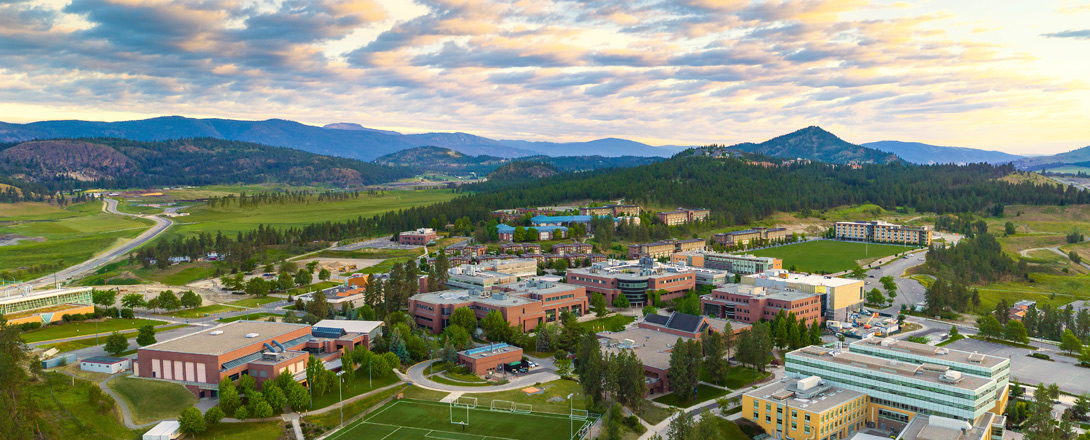
UBC’s Okanagan campus borders the dynamic city of Kelowna, a hub of economic development with a population of about 150,000 people—the fourth fastest growing population in Canada. In fact, the Okanagan Valley is rated one of the best communities in Canada to grow your business.
More than 160 buses travel daily from campus to key locations such as Kelowna’s cultural district and thriving downtown waterfront. The campus is two minutes from the Kelowna International Airport, one of the top 10 busiest airports in Canada.
UBC Okanagan is situated within the First Nations territory of the Okanagan Nation, whose spirit of stewardship for the land is reflected in the university’s respect for sustainability.
A diverse natural region with sandy beaches, beautiful farms, vineyards and orchards, and snow-capped mountains, the Okanagan Valley features sweeping stretches of lakeside and endless mountain trails for biking and hiking.
Check out this 360-degree video: Kelowna From Above.*
* Best viewed using desktop Chrome or Firefox (desktop) or YouTube app (mobile).
Full-time UBC Okanagan students can live in residence, which offers modern living with easy access to academic and personal support. Residences are surrounded by hiking and biking trails, plus panoramic views of the campus and valley.
* UBC does not verify or endorse information shared on this third-party website, which is offered here as a public resource only.
Clubs: Make friends with similar interests, attend events, and explore career options with the UBCO Nursing Course Union.
Events: Various orientations help graduate students to explore, discover and learn about the School of Engineering, UBC Okanagan, and living in the Okanagan Valley.
Stay active: Take advantage of the many opportunities to get involved and play—from workout space in the new Hangar Fitness and Wellness Centre and our 1,561 square-metre gymnasium, to athletic courts, intramurals, fitness classes and nationally ranked varsity athletics. Have a ball in Sports and Recreation.
Relax: The Graduate Collegium is a gathering place where grad students can hang out, eat lunch, spend time with their fellow students, and attend or host special events. The lounge-style room is open seven days and week and is outfitted with comfortable furniture, kitchen facilities, and individual and group-work spaces.
College of Graduate Studies: Your hub for administrative support and such things as graduate workshops for professional development and for assisting you from the admissions process through to your graduation.
Centre for Scholarly Communication: Supports graduate students, post-doctoral fellows, staff, and faculty in disseminating their research. The Library’s CSC provides one-on-one consultations and workshops, including writing support for theses, dissertations, journal articles, and grant proposals.
Centre for Teaching and Learning: Provides support related to teaching, TA training, and use of technology in educational programming.
As a professional nurse, and a graduate of the MSN program, you will be qualified to provide professional nursing services, deliver health-education programs, and provide consultative nursing services to promote, maintain and restore patient health.
Map out your future and prepare to hit the ground running with resources and services provided by the Advising & Involvement Centre.
Tell your story with resumé and cover-letter strategies, and search Work Study jobs for experience relevant to your degree and career goals. You can also book an appointment to meet one-on-one with our career advisor.
alumni UBC is a member-driven association that offers a variety of lifetime programming and communications to enrich the lives of UBC graduates.
The ‘Your Next Step’ program offers webinars, speaker series and professional development sessions. It is designed to provide advice, tips and resources in areas of career development to graduates for life after university.
Realize the promise of a global community with shared ambition for a better world and an exceptional UBC.